Environment
Coatings against microbiologically influenced corrosion, and materials for cleaner water.
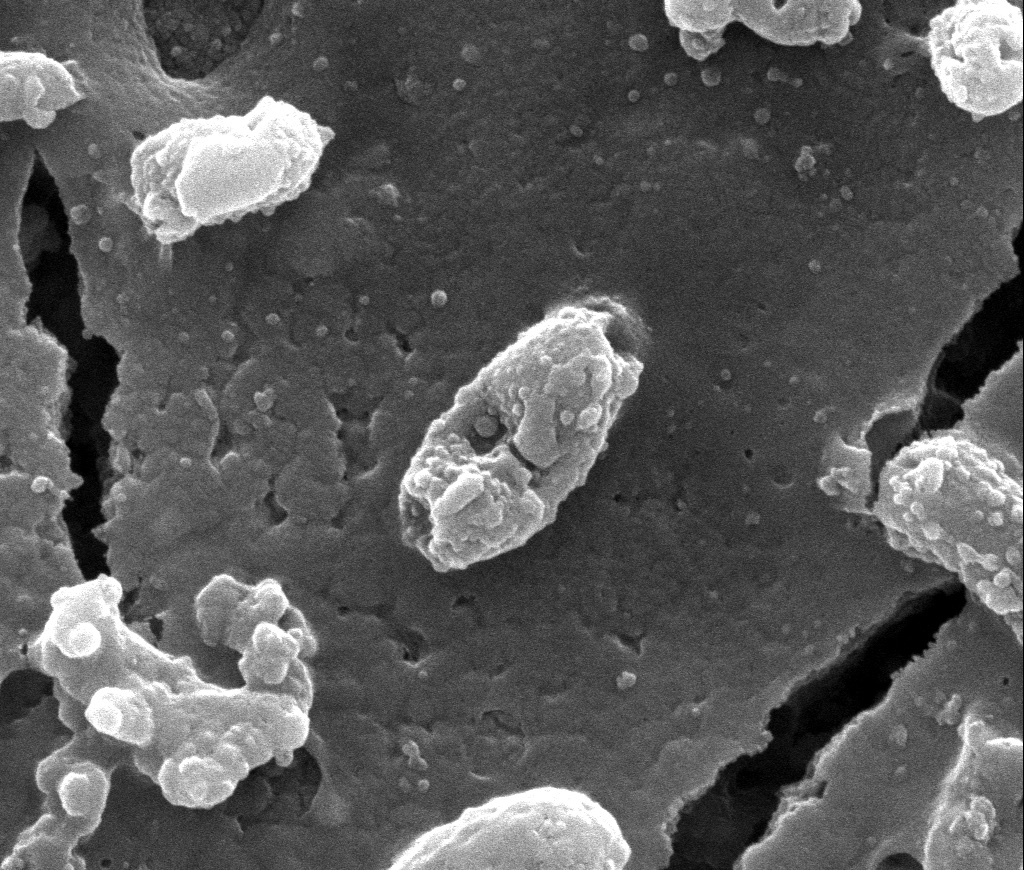
In seawater, bacteria eat into steel.
Microbes settle on metal, filters and pipes and form biofilms. On metal in seawater, they speed up corrosion; in water systems, they foul membranes and carry contaminants.
We build coatings from polyoxometalate ionic liquids that are antimicrobial and anticorrosive at the same time, antibiofouling compounds for water filters, and materials that help remove microplastics from wastewater.
The aim is materials whose activity is controlled, so that they protect the surface without becoming a contaminant themselves.
- Line 01 Redox-Active Polyoxometalate-Based Functional Materials How redox state, composition and local environment govern what a polyoxometalate can do — and the design rules that follow.
- Line 02 Nano- and Hybrid Materials for Antimicrobial and Biofilm Control What happens at the nano–bio interface, so antimicrobial efficacy can be decoupled from cytotoxicity and environmental impact.
- Line 03 Materials–Surface and Materials–Biology Interactions in Complex Environments How materials behave on real surfaces and living systems over time, outside idealised laboratory conditions.
- Scott G. Mitchell Scientific Researcher, CSIC
- Nicolás Gracia Vallés Postdoctoral Researcher, CSIC
- Mariella Malefioudaki PhD student, Organic Chemistry programme