Health
Antimicrobial materials that answer antimicrobial resistance and healthcare-associated infections.
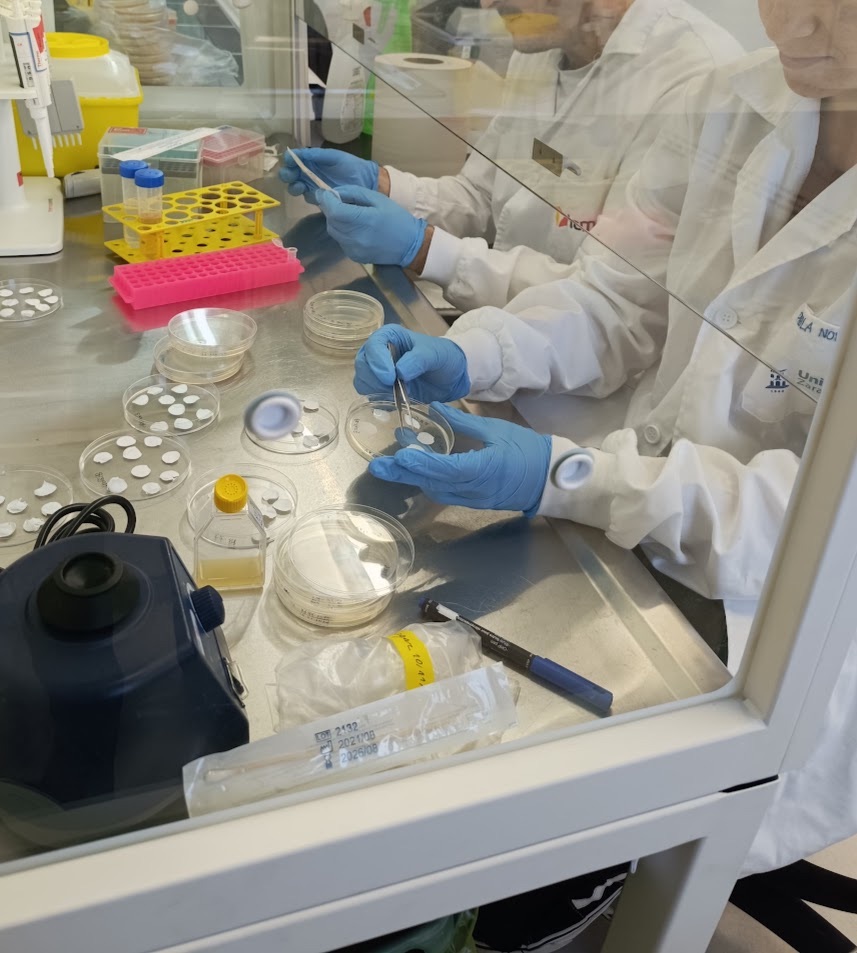
Bacteria learn to resist our antibiotics.
Antimicrobial resistance is making common infections harder to treat, and biofilms on medical devices and hospital surfaces are a constant source of healthcare-associated infections.
We design hybrid materials — polyoxometalates combined with peptides and polymers, nanoparticles, polymer nanogels — that act on microbes through mechanisms other than antibiotics: disrupting membranes, inducing oxidative stress, interfering with metabolism. Applied as coatings, they aim to stop biofilms forming in the first place.
Each material is tested against its toxicity as well as its efficacy: the goal is to kill the microbe, not the cell next to it.
- Line 01 Redox-Active Polyoxometalate-Based Functional Materials How redox state, composition and local environment govern what a polyoxometalate can do — and the design rules that follow.
- Line 02 Nano- and Hybrid Materials for Antimicrobial and Biofilm Control What happens at the nano–bio interface, so antimicrobial efficacy can be decoupled from cytotoxicity and environmental impact.
- Scott G. Mitchell Scientific Researcher, CSIC
- Rafael Martín Rapún Associate Professor, University of Zaragoza
- Anabela Carnicero Postdoctoral Researcher, CSIC
- Paula Novella Rodríguez PhD student, Organic Chemistry programme