Heritage
Protecting paintings, stone and silk from biodeterioration, with treatments designed to be compatible and reversible.
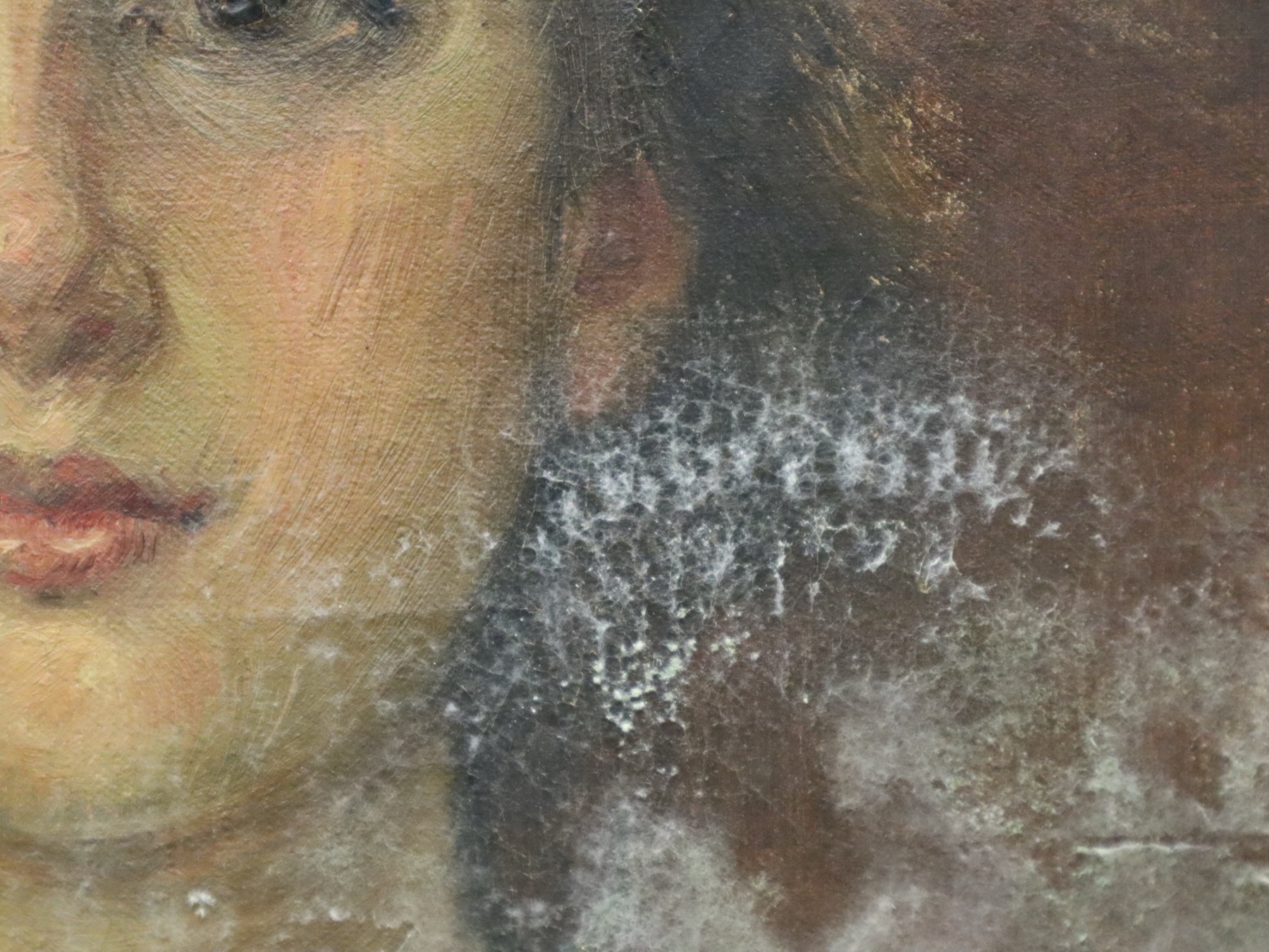
After a flood, mould spreads across a portrait.
Fungi and bacteria colonise paintings, textiles, paper and stone, and the damage they leave behind is often irreversible. Conventional biocides can harm the object they are meant to protect, or the people who apply them.
We design treatments that conservators can actually use: chitosan gels that remove microbial colonisation from oil paintings, consolidants for fragile historical silk, natural formulations against biodeterioration of built heritage, 2D nanomaterials and antimicrobials for documentary heritage. Every treatment is judged by the conservator's criteria — compatibility with the original, reversibility, and a protocol that works outside the lab.
We work with restorers, museums and heritage institutions, from the Valencia paintings damaged in the 2024 floods to Maya architecture in Yucatán.
- Line 02 Nano- and Hybrid Materials for Antimicrobial and Biofilm Control What happens at the nano–bio interface, so antimicrobial efficacy can be decoupled from cytotoxicity and environmental impact.
- Line 03 Materials–Surface and Materials–Biology Interactions in Complex Environments How materials behave on real surfaces and living systems over time, outside idealised laboratory conditions.
- Scott G. Mitchell Scientific Researcher, CSIC
- Águeda Sáenz Martínez MSCA Postdoctoral Researcher, CoNFine project
- Nicolás Gracia Vallés Postdoctoral Researcher, CSIC
- Griselda Pérez Ireta PhD student, CONAHCYT fellow
- Maria Teresa Avilés PhD student, UNITA fellow (FCT)
- Alba Ibort Gracia Early-career researcher